
Contest
The Illegal Waste Dumping Detection (IWDD) Contest is an international competition aimed at fostering the development of advanced methods for real-time illegal waste dumping detection in videos acquired by fixed CCTV cameras and deployable on smart cameras or embedded systems.
Global Impact
Illegal dumping constitutes a major global issue, burdening municipalities with cleanup costs, harming ecosystems, and threatening public health.
Data Scarcity
The availability of comprehensive, well-annotated video datasets remains limited. Most existing studies rely on private datasets, which hinders progress toward intelligent surveillance systems.
Technical Challenge
Variations in human behavior, waste types, and environmental factors substantially reduce the effectiveness of conventional models.
Types of Dumping Actions
The difficulty of detecting illegal waste dumping stems from the need to recognize heterogeneous behavioral patterns. Dumping actions can be grouped into two distinct types, each posing specific detection challenges and requiring specialized temporal modeling approaches.
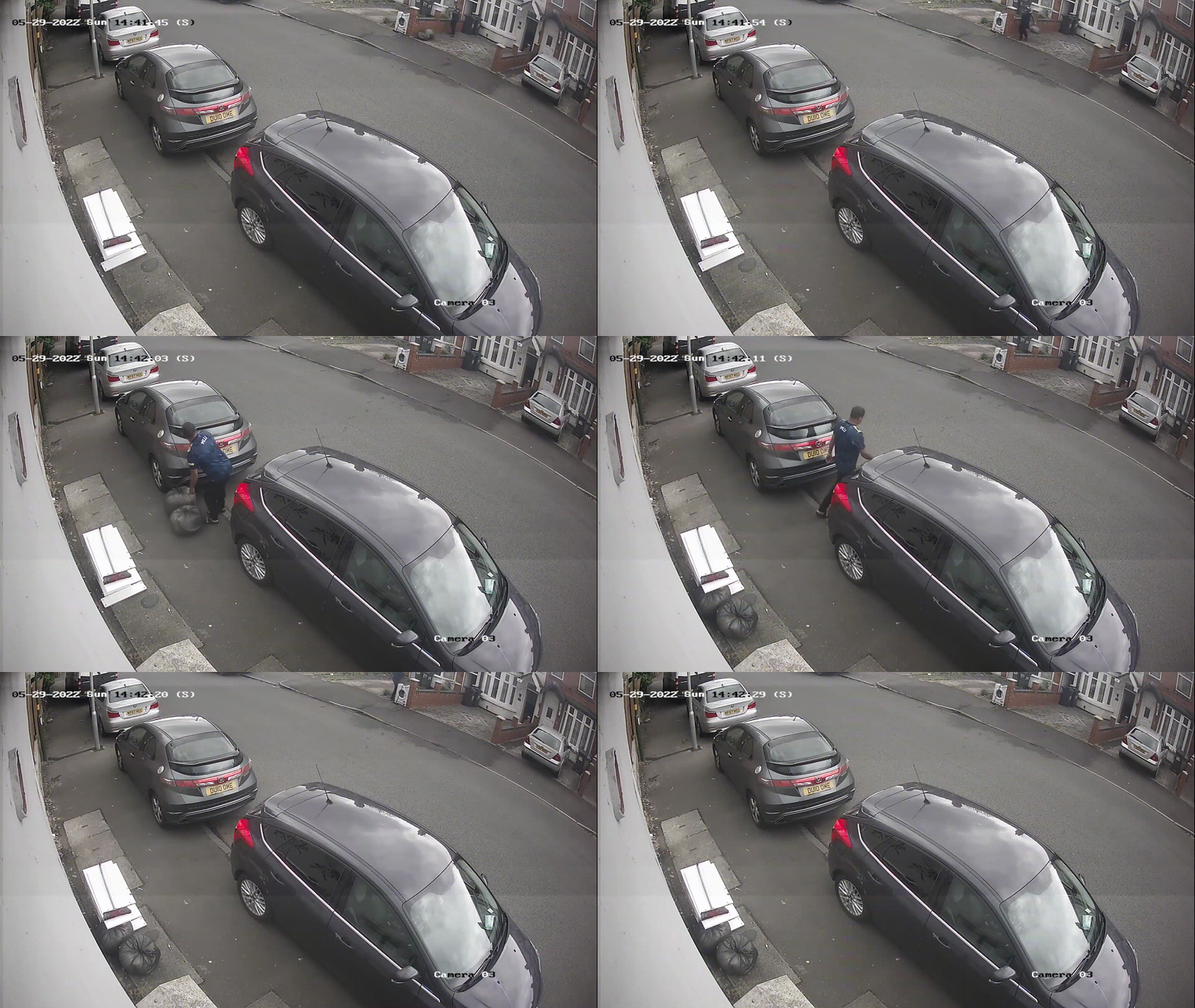
STATIC DISPOSAL
Waste is deliberately placed and left at a specific location, for instance, garbage bags, furniture, or bulky items abandoned on the street or in unauthorized areas.
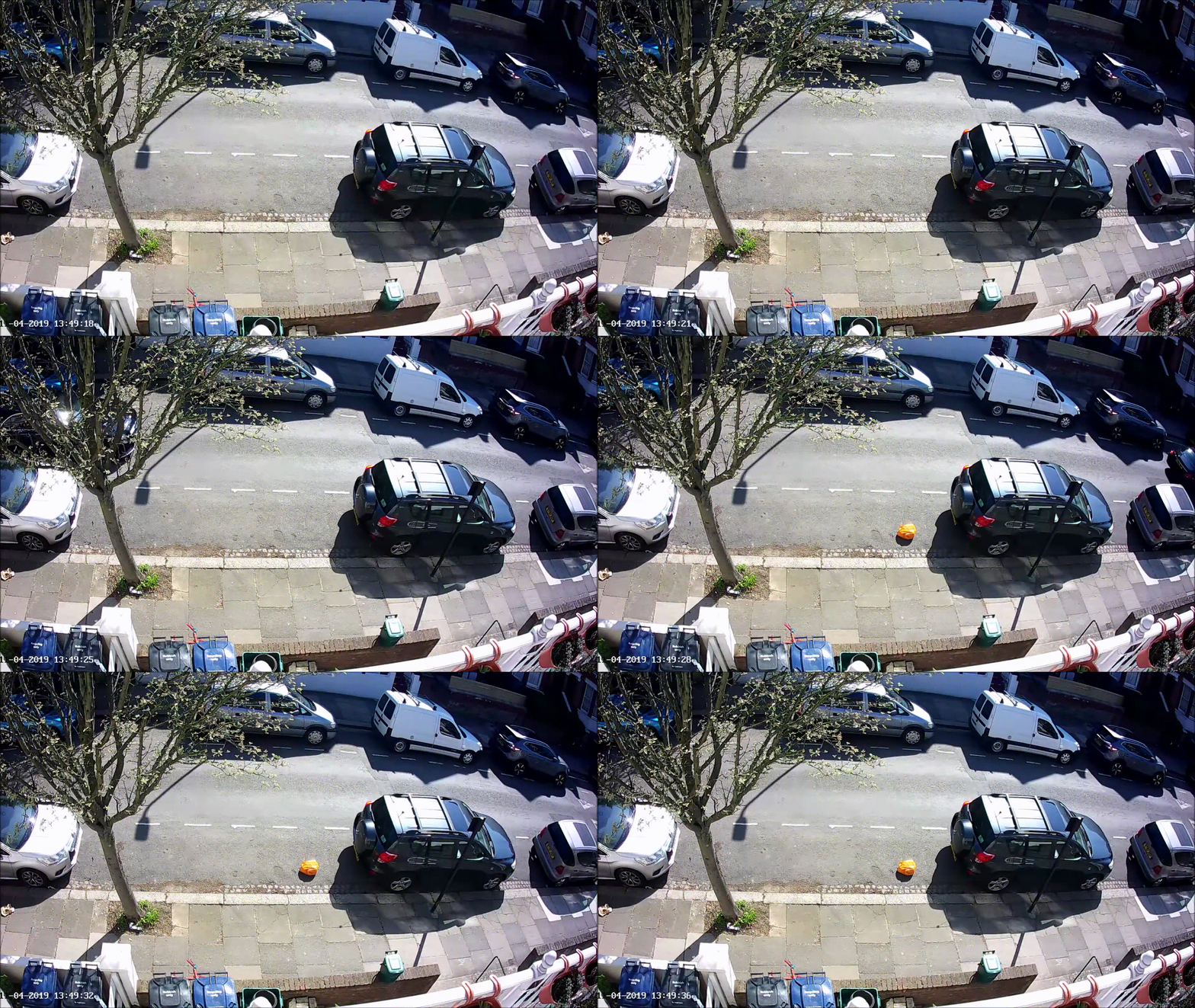
DYNAMIC DISPOSAL
Spontaneous and quick disposal actions performed while in motion, such as tossing waste from a moving vehicle, dropping litter while walking, or rapidly discarding objects during brief stops.
MIVIA-IWDD Dataset
The MIVIA-IWDD dataset is a comprehensive collection of video clips specifically devised to train and evaluate action recognition models for the detection of illegal waste disposal events. The MIVIA-IWDD dataset is completely balanced, so as to ensure unbiased model training and robust evaluation.
Total Videos
Positive Samples
Negative Samples
Resolutions
Temporal Annotations
Each positive video is provided with precise timestamp annotations that mark the exact moment when illegal dumping occurs, thereby enabling fine-grained temporal action localization and early detection training.
Real-World Diversity
Videos are captured under diverse real-world conditions: day/night scenarios, varying illumination, various camera angles, and heterogeneous environmental contexts, so as to ensure robust model generalization.
Balanced Distribution
A balanced dataset with equal representation: 250 positive samples (125 static + 125 dynamic) and 250 negative samples, which ensures unbiased training and fair evaluation metrics.
Challenging Negative Samples
Challenging negative samples deliberately feature difficult scenarios without dumping events, encouraging models to distinguish normal activities from illegal waste disposal and to reduce FP.
Evaluation Protocol
The submitted methods are evaluated according to 3 complementary metrics: Precision, Recall, and F1-Score. The private test set comprises both strong positive samples (videos containing illegal waste dumping events) and negative samples (videos devoid of any dumping activity).
Each prediction is assessed by comparing the ground-truth dumping instant g with the predicted dumping detection instant p. The instant g denotes the first frame where the dumping action becomes visible, and is manually annotated after a complete review of the video. A tolerance of 3 seconds is granted to reward early detection, whereas any prediction occurring more than 10 seconds after g is discarded.
Accordingly, each detection is assigned to one of the following three categories:
- True Positives (TP): detections in positive videos that fall within the valid time window centred on g.
- False Positives (FP): detections in negative videos, or in positive videos occurring too early or too late with respect to the valid time window.
- False Negatives (FN): positive videos for which no detection occurs.
From these three sets, the following standard metrics are derived:
Precision
Quantifies the method's ability to reject false alarms; higher values correspond to fewer false positives.
$P = \frac{|TP|}{|TP| + |FP|}$
Recall
Quantifies the method's sensitivity in detecting dumping events; higher values correspond to fewer missed events.
$R = \frac{|TP|}{|TP| + |FN|}$
F1-Score
Provides a balanced trade-off between Precision and Recall, defined as their harmonic mean.
$F_1 = 2 \times \frac{P \times R}{P + R}$
Winning Criterion
The F1-Score constitutes the primary metric for ranking the submitted methods and determining the winner of the contest. The method attaining the highest F1-Score on the private test set is declared the winning method; whenever two or more methods achieve comparable F1-Scores, the GPU memory consumption is adopted as a secondary criterion, favouring the more memory-efficient solution.
Rules
- The deadline for the submission of the methods is 10th October, 2026. Submissions must be sent via email, providing, directly or through external links, the trained model, the source code, and a technical report. Participants are invited to follow the detailed instructions reported here.
- Participants may obtain the training set and its annotations by sending an email, indicating the name of their team.
- The provided samples and annotations may be used to train and validate the proposed methods; participants are nonetheless encouraged to exploit additional external data in order to further improve the performance of their models.
- Participants are strongly encouraged to submit a contest paper to WACV 2027, whose deadline is 15th October, 2026. Papers must be formatted using the official WACV 2027 Author Kit Template, which provides all the LaTeX files, style sheets, and formatting guidelines required for submission. Detailed formatting instructions are available on the workshop website here, and accepted papers will be included in the WACV 2027 Workshops Proceedings here.
Instructions
The methods proposed by the participants are executed on a private test set. In order to grant participants full freedom in the choice of software libraries and to faithfully reproduce their processing pipeline, the evaluation is carried out on Google Colab (see this tutorial), by running the submitted code on the samples of the private test set.
Accordingly, participants must submit an archive containing the following elements:
- A Python script test.py that receives as input the folder containing the test videos (--videos) and produces, for each video, a TXT file reporting the detection time (or nothing) in an output folder (--results). The script is therefore executed with the following command: python test.py --videos foo_videos/ --results foo_results/
- A Google Colab notebook test.ipynb that install all the required dependencies and executes the test script.
- All the additional files required to run the test, such as the trained model, auxiliary scripts, and any other supporting resources.
- The provided sample script also reads the TXT annotation files: each file contains the illegal waste dumping instant or nothing. The result files follow exactly the same format, and the sample script likewise shows how the result files are written.
The submission must be sent by email: the archive may be attached directly or shared through external links. Participants are strongly encouraged to follow the provided code example when preparing their submission.